A 30-Minute Cricket Practice Plan for Busy Players
Most club players do not lose their game in the nets. They lose it to a calendar that never quite has a free evening. A two-hour session sounds ideal until work runs late, the ground gets locked and the weekend arrives with your feet stuck in concrete.
Thirty minutes will hold your game together. It will not make you a better player than a long session would, but three short sessions a week will beat one rushed hour every time. The trick is to stop treating 30 minutes as a squeezed version of a long net and treat it as its own format: tight, specific, and repeatable.
The Shape of a 30-Minute Session
The blocks never change. Only the specifics inside them do. Keep the order fixed so you never waste the first five minutes deciding what to do.
- 0–5 minutes: warm-up and shadow movement
- 5–15 minutes: batting
- 15–22 minutes: bowling
- 22–28 minutes: fielding and reactions
- 28–30 minutes: cool down and one note for next time
Before you start, pick a single focus and say it out loud. "Front-foot drive to mid-off." "Landing six balls on off stump." "Pick up cleanly on the move." One focus per session. Two is a wish list, and a wish list turns into a wandering half hour.
Have everything within arm's reach: bat, ball, a cone or a folded towel as a target, and a phone timer. Hunting for gear is how a 30-minute plan becomes a 15-minute one.
Minutes 0–5: A Warm-Up That Wakes Up the Right Muscles
Skip the slow lap around the block. Your shoulders, hips and calves need to be switched on, and they need it fast.
- One minute of brisk walking, side-steps or light jogging on the spot.
- Twenty arm circles forward, twenty back, then shoulder rolls and gentle neck turns.
- Fifteen leg swings each side, holding a wall or fence for balance.
- Ten trunk twists, then ten slow bodyweight squats.
- Finish with ten shadow cover drives and five shadow pulls at about 60 percent speed.
That last step matters more than the rest. Shadow batting warms the muscles you are about to use and reminds your body what a proper shot sequence feels like before a ball is anywhere near you.
Minutes 5–15: Batting — One Skill, Lots of Reps
Ten minutes of batting is roughly 30 to 40 balls with a partner, which is plenty if every ball has an intent. Twenty careless balls are worth less than eight deliberate ones.
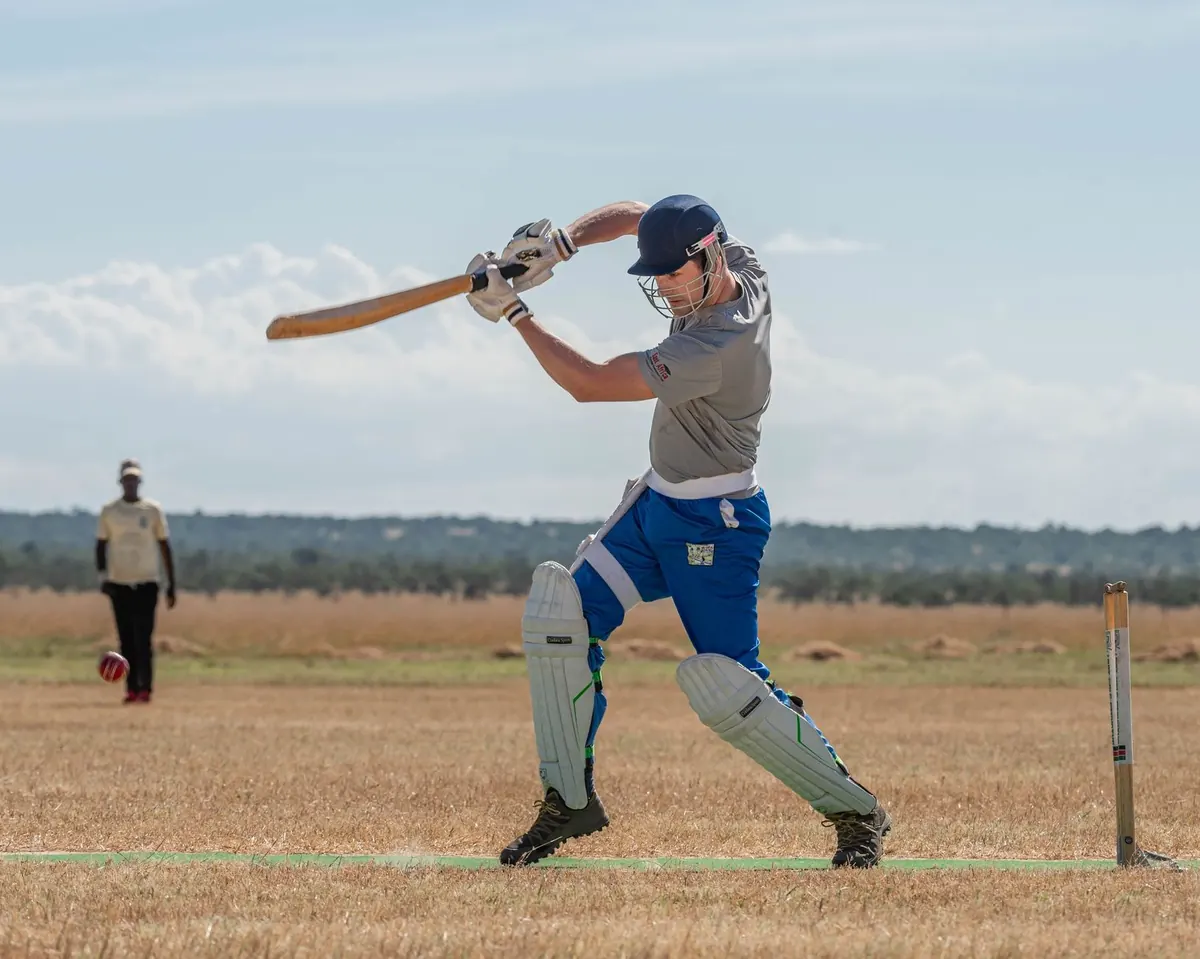
If you have a partner, work in sets of ten. One set of drives, one set of pull shots, one set of defensive pushes against a ball aimed at the stumps. Call the shot before the ball is bowled so your feet start moving early.
If you are on your own, the wall is your best coach:
- Target drives. Chalk a small square on a wall at knee height. Hit it twenty times with a front-foot drive, then twenty with a back-foot punch. Reset your grip and stance after every five.
- Wall reaction. Throw a tennis ball against the wall from three metres, let it bounce, and hit it as it comes back. Twenty reps, then switch hands for the throw.
- Shadow with a cone. Place a cone where you want your front foot to land and step to it on every rep. Footwork first, hands second.
Keep the hands close to your body through the shot and hold your finish for a second so you can feel whether you lost balance. If three reps in a row feel loose, slow down rather than speeding up.
Minutes 15–22: Bowling With a Target
Seven minutes gives you about 18 to 24 balls. Bowl them in sets of six with a scoring rule, otherwise it is just exercise.
Put a marker on the pitch — a cone, a towel, a chalk line — and give yourself a goal: four out of six balls landing on off stump, or six balls in a row on a good length. Count them honestly. If you have no pitch, bowl at a single stump from a shorter run-up, or into a net or against a wall with a soft ball.
For seamers, the focus is rhythm rather than pace. A shortened run-up that you can repeat is more useful in a short session than a long one you cannot control. For spinners, use the sets to work over and around the wicket alternately, and watch where your front foot lands each time.
Two things to check without a coach: does your arm come over in the same place every ball, and does your follow-through finish towards the target? Those two habits hold an action together between longer sessions.
Minutes 22–28: Fielding and Reactions
Fielding is the easiest part of your game to lose and the quickest to get back. Six focused minutes is enough.
- Pick up and throw. Ten balls on your strong side, ten on your weaker side. Bend at the knees, gather cleanly, and throw at a target on the wall or at a single stump from 15 metres.
- Wall catches. Stand three metres from a wall, throw underarm, and catch the rebound with soft hands. Ten with the right hand, ten with the left, ten with two hands above the head.
- Footwork. Twenty crossover steps in a zig-zag, or walk-throughs where you jog three steps and pick up a stationary ball on the move.
Do not jog this section. Move at match pace so your heart rate is up and your hands are working under mild pressure.
Minutes 28–30: Cool Down and One Note for Next Time
Walk for a minute, then stretch your calves, hamstrings, shoulders and forearms. Nothing heroic — long, easy holds while you breathe.
Then write one line in your phone: what worked, and one thing to fix. "Drives good, front foot late on the pull." That note is the thread that connects three short sessions into a week of real work. Next time you train, read the note first and make that the focus.
Making It Work in a Real Week
Three 30-minute sessions across a week will do more for your game than a single long net on Saturday. Aim for batting twice, bowling twice, and fielding every time, even if the fielding block is only three minutes.
When life gets tighter, shorten the blocks rather than cutting one out. A 15-minute version looks like this: three minutes warm-up, five minutes batting, four minutes bowling, three minutes fielding. It still counts, and it keeps the habit alive.
Space and equipment are rarely the real obstacle. A driveway, a garage, a hallway, a park corner or a flat roof all work. A sock ball or tennis ball is fine indoors, a cricket ball against a wall is not. No partner? The wall never cancels on you. If you have children around, hand them the ball and let them throw — you get throwdowns and they get entertained.
Keep the kit bag packed and near the door, and set the timer before you start, not during. If something hurts beyond ordinary soreness, or a niggle lingers for more than a week or two, get it looked at by a doctor or physio rather than training through it.
The goal of 30 minutes is not volume. It is arriving at the weekend with hands that remember what they are doing and feet that move before the ball does. Three short sessions a week, done with a plan and one clear focus, will show up in your first over.
Photo: Engineer John / Pexels